|

| NEW ARRIVALS |  |
FURNITURE | |
LIGHTING | |
TAPESTRIES | |
PAINTINGS | |
PRINTS | |
CERAMICS | |
OBJETS D'ART |
| RETURN TO MAIN CARTOON PAGE |
| TAPESTRY CARTOONS A SHORT HISTORY |
Aubusson and Felletin are famous the world over, In 2009 Aubusson tapestry was listed as World Heritage by UNESCO. In 1884 a national school for the decorative arts (ENAD Ecole Nationale d'Art Decorative) was finally opened. The school consisted of a large room where instruction was given in weaving along side art classes. 122 boys and 88 girls over the age of twelve were instructed in the various stages of tapestry manufacture. The following year a museum of tapestry was opened under the same director, where cartoons and tapestries were displayed Aubusson is particularly known for large verdure tapestries, the cartoons for these large wall hangings have a depth and calm reminiscent of the woodlands of central France, which were their inspiration. Identifiable plants, and views of distant chateaux all have a great decorative appeal. Roses, lilac and poppies abound on the designs for the seats of chairs and sofas, smaller fragments that were pinned over the centre of these designs when weaving tapestries for sets of chairs show scenes from la Fontaines fables, luxuriant bunches of flowers and simple farm yard animals. All of these paintings have an undeniable charm and quality, all of which makes them highly desirable for their decorative appeal. |
|
Tapestry cartoons are the life size models from which tapestries are woven. Painted in oil on canvas or gouache on paper, these paintings gave life to the smallest cushion to the largest of wall hangings. The wools and silks were dyed to match the painting, and the weaver then copied it. Working with the cartoon under the warp threads of the loom, at a rate of approximately two square metres per month, per worker, the final tapestry slowly appeared. The quality of the finished tapestry was largely dependant on the artistry of the cartoon painter combined with the skill of the weaver. The earliest cartoon painters were usually local artists designing for the local manufacturers. Cartoons could be simple full size line drawings, where the artistry of the weaver was left to fill in the colours, or full size, full colour paintings, where the weaver copied exactly what was before him. Often different painters specialized in landscapes, flowers, animals or figurative subjects. Several painters could have been employed on a single cartoon. The cartoon painter's job was to create a cartoon, from what might have been a great painting, for the weavers to work on. However, a famous painting might be entrusted to a master weaver. The earliest centre for the weaving of tapestries in France, can be traced back to 1457 in a small town situated on the banks of the river Creuse, Aubusson is now associated the world over for its tapestries. In 1665 Louis XIV gave the title "Manufacture Royale d'Aubusson" to the various manufacturers working in the town of Aubusson. In 1731 a painter arrived in Aubusson, appointed by Louis XlV to the service of the Manufacture of Tapestries. Jean-Joseph Dumons, born in 1687, worked the in Aubusson until 1755. It was at this time that a school was opened to teach painters working for the tapestry industry. Dumons was followed by Jacques Juillard, a pupil of Francois Boucher, considered by some to be a greater designer of tapestries than a painter. |
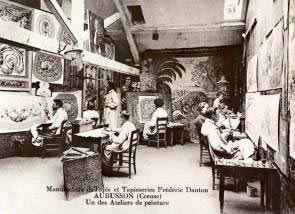
Cartoon painters at work at the of the century, circa 1900
|
1731 became a turning point in the history of Aubusson. It was a time when the great painters of France were working with the industry. Jean-Baptiste Oudry had been appointed both painter to, and artistic director of Beauvais in 1726, Le Brun, Boucher and Dumons were working in Aubusson. The 17th and 18th centuries saw some of the greatest French tapestries produced. Scientific advances in the 18th century saw the introduction of many new colours for the dying of the wools. From an original palate of very few colours with the wools dyed with natural dyes, the quest for a greater number of colours reached a height in the mid 19th century when Michel-Eugene Chevreul the colour physicist who directed the Gobelins dyestuffs laboratory composed a palette of 14,400 colour tones. However, it was becoming apparent that these new colours were not light resistant and in 1919 Marius Martin director of the regional Decorative Arts School, suggested that the weaver's range should be reduced to simple and above all durable colours. |
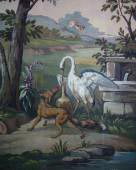 The Fox and the Stork, after La FontaineGouache on paper, C. 1880 |
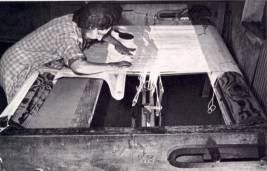 Weaving above a cartoon, on a low warp loom. |
| RETURN TO MAIN CARTOON PAGE |
| © ALL RIGHTS RESERVED 1999-2026 |